
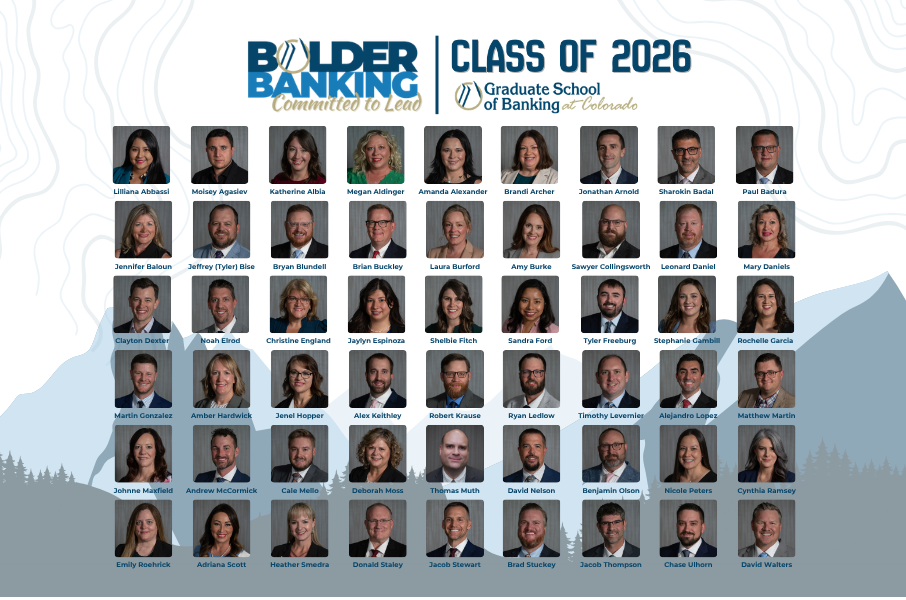
In 2026, 118 GSBC students chose to go beyond the traditional graduate school experience through Committed to Lead, a supplemental micro-credential focused on putting leadership development into practice.
Fifty-four students completed the program and earned the Committed to Lead micro-credential this year, while another 64 second-year students are currently working toward it.
Throughout the program, all 118 students reflected on their own leadership and identified ways to put what they were learning into practice at their institutions. Their journals offer a window into what community bankers are thinking about, working toward and preparing to change.
Develop future leaders deeper in the organization. Test a liquidity plan before it is needed. Give emerging leaders a broader view of the bank. Find practical applications for AI. Spend more time with customers at their businesses.
We pulled 12 ideas from those journals that are worth sharing with fellow community bankers.
But first, we’re proud to recognize the 54 members of this year’s class who followed through on that extra commitment and earned the Committed to Lead micro-credential.

Now, consider this an invitation to borrow a bold move.
Build More Leaders
- Expand succession planning beyond the CEO.
A bank may have a carefully developed CEO succession plan while remaining highly dependent on a commercial lender, operations executive, compliance officer, branch manager or other key employee.
Look deeper into the organization. Which roles would be difficult to replace tomorrow? Who could step in today? Who could be ready with additional development?
Succession planning becomes much more valuable when it prepares the entire organization for change.
- Give high-potential employees an executive-level view of the bank.
Create opportunities for emerging leaders to attend an ALCO meeting, participate in strategic planning, observe a board meeting or spend time with executives outside their functional areas.
Strong specialists do not automatically become strong enterprise leaders. Future leaders need opportunities to understand how credit, liquidity, deposits, technology, compliance, operations and strategy work together before they are asked to lead across them.
- Use delegation as a development tool.
Delegation is often viewed as a way for senior leaders to free up time. But every responsibility a senior leader continues to perform unnecessarily may be a responsibility someone else is not learning to perform.
Moving the right responsibilities creates experience and judgment for emerging leaders while giving senior executives more capacity to focus on strategy, people, customers and the future.
- Create more cross-functional learning.
Let a lender spend time with deposit operations. Invite an operations employee into a credit discussion. Give a future executive exposure to finance, compliance or technology.
Specialization is necessary, but it can also create silos. Cross-functional experience helps employees understand how decisions in one part of the bank affect another.
Strengthen Your People Practices
- Make employee development more intentional.
Onboarding can be more than paperwork, policies and system access. It is an opportunity to teach employees how the bank works, what it values and how their roles contribute to its goals.
That intentionality can continue through annual employee goals and more structured manager feedback. Clear expectations and useful feedback help employees understand what success looks like and where they can grow.
Test Your Readiness
- Put your liquidity plan through a tabletop exercise.
Having a contingency plan is one thing. Knowing whether the management team can execute it under pressure is another.
Who has authority to make decisions? Who contacts key funding sources? Who communicates with the board and regulators? What information will management need immediately?
A tabletop exercise can uncover gaps and assumptions before the answers really matter.
The same approach can be applied to cyber incidents, fraud, operational disruptions and leadership transitions.
Put AI to Work
- Use AI to check vendor contracts against invoices.
Instead of beginning with AI as a broad technology initiative, start with a specific business problem.
One student identified an opportunity to use AI to compare vendor contracts with invoices and flag possible overbilling. It is a focused use case with a clear purpose and measurable value.
- Make policies and procedures easier to use.
An AI-searchable repository could help employees navigate bank policies and procedures more easily and get to the information they need when they need it.
The opportunity isn’t simply faster search. It is making existing knowledge more accessible across the organization.
- Pilot AI in lending.
Underwriting, financial analysis, credit memos and policy exceptions all present opportunities to explore where AI could support employees.
The goal isn’t to replace human judgment. It is to identify repetitive work technology may be able to assist with so bankers can spend more time on analysis and decision-making.
- Explore BSA and fraud as focused AI use cases.
BSA and fraud monitoring may offer another place to test AI against a defined business need.
Across these applications, the bigger opportunity may be what happens to the capacity technology creates. If AI gives an employee five hours back each week, could those hours go toward customers, employee development, risk analysis or other higher-value work?
Practical training and clear governance matter, too. Employees need to understand where and how these tools can be used responsibly rather than being left to figure it out individually.
Strengthen Connections
- Get bankers out of the bank.
As technology reduces the number of interactions that require customers to enter a branch, bankers need to be more intentional about going to them.
Encourage lenders and other relationship-focused employees to get out of the bank, visit customers and prospects at their businesses and spend more time listening to what is happening firsthand.
Those conversations do more than strengthen relationships and support business development. They can reveal emerging needs, challenges and changes in the market that are difficult to see from inside the bank.
- Give the organization something to rally around.
One student plans to establish a bank-wide annual theme supported by visual communication and branding.
It is a simple idea with a broader purpose: reinforce shared priorities and create stronger alignment across departments and locations.
The Next Move Is Yours
These 12 moves came from bankers looking closely at their own institutions and identifying something they could make better.
That’s what makes them worth sharing.
A succession strategy at one bank might spark a leadership development idea at another. A liquidity exercise might expose a preparedness gap. An AI use case might solve a problem another banker has been trying to address. Even a relatively simple change in onboarding, delegation or customer engagement can create meaningful momentum.
Not every move will make sense for every bank. That’s not the point.
The opportunity is to learn from what fellow community bankers are putting into practice, adapt what fits and find one move worth taking back to your own bank.
Which one will you take back to yours?